The Complete MLOps Platform: 25 Posts, 8 Layers, One Architecture
Series finale. 25 posts of MLOps for DevOps engineers, condensed into one 8-layer architecture. Every tool. Every layer. The full picture in one post.
25 posts. One platform. Every tool a DevOps engineer already knows.
When this series started in February, MLOps felt like a separate discipline. Specialized tools. Unfamiliar workflows. A whole new vocabulary that seemed disconnected from everything you already knew.
25 posts later, here is what actually happened: every single pattern mapped back to something you have been doing for years.
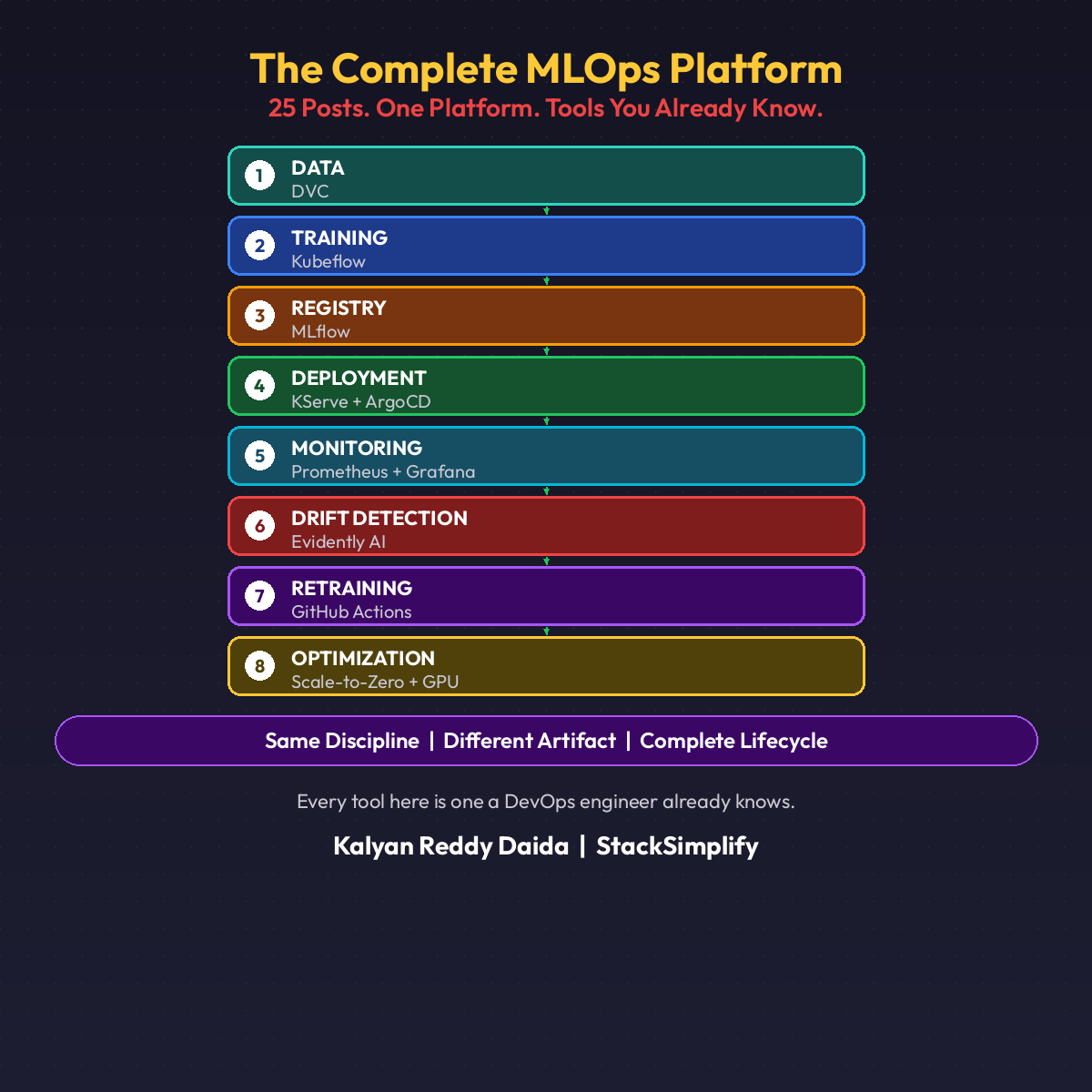
The Complete Architecture
Eight layers. Each solves a specific production problem.
| Layer | Tools | Purpose |
|---|---|---|
| Data | DVC + S3 | Version datasets like code |
| Training | MLflow + Kubeflow | Track every experiment automatically |
| Registry | MLflow Registry | Promote models through aliases, not manual tags |
| Deployment | KServe + ArgoCD | Transformer-predictor pattern + GitOps |
| Monitoring | Prometheus + Grafana | Catch performance degradation in real time |
| Drift | Evidently + scheduled jobs | Detect when production data shifts |
| Retraining | Kubeflow Pipelines | Orchestrated rebuild with quality gates |
| Optimization | Karpenter + HPA | Scale to zero, right-size, control cost |
The Full Tool Stack
12 tools. Zero that require abandoning your existing DevOps stack.
| Tool | Role | Series Post |
|---|---|---|
| DVC | Version control for datasets | Part 4 |
| MLflow | Experiment tracking + model registry | Part 2, Part 16 |
| Kubeflow Pipelines | Orchestrate multi-step ML workflows | Part 14 |
| KServe | Model serving with canary rollouts | Part 6, Part 7 |
| Prometheus + Grafana | Metrics + dashboards | Part 10 |
| ArgoCD | GitOps-driven model deployment | Part 17 |
| GitHub Actions | CI/CD pipeline with quality gates | Part 17, Part 19 |
| Feast | Feature store for consistent features | Part 15 |
| Evidently | Data drift detection | Part 11 |
| Karpenter | Kubernetes node autoscaling | Part 18 |
| SHAP | Model explainability | Part 9 |
Every tool runs on Kubernetes. Every tool integrates with Git. Every tool has a DevOps equivalent you already understand.
How It All Connects
The Data Flow
S3 bucket stores raw data. DVC tracks versions. Feast serves features to both training and inference.
The Training Flow
GitHub Actions triggers Kubeflow Pipeline. Pipeline pulls data via DVC, computes features via Feast, trains the model, logs to MLflow. Quality gate compares candidate vs champion. If promoted, model gets the @champion alias.
The Deployment Flow
GitHub Actions builds a container with the new model URI. ArgoCD detects the Git change. KServe deploys with canary split (80/20). Smoke tests validate. If passing, promote to 100%.
The Monitoring Flow
Prometheus scrapes prediction metrics from KServe. Grafana dashboards display them. Alertmanager fires when thresholds breach.
The Feedback Loop
Evidently runs scheduled drift detection. When drift crosses threshold, it triggers retraining. Kubeflow Pipeline rebuilds the model. Quality gate decides. The cycle repeats.
Data > Train > Register > Deploy > Monitor > Detect > Retrain
                            ↑                              │
                            └──────────────────────────────┘
The DevOps Parallel: Final Mapping
| DevOps | MLOps |
|---|---|
| Container registries | Model registries |
| CI/CD pipelines | Training pipelines |
| Prometheus dashboards | Model monitoring |
| Git versioning | Data versioning (DVC) |
| GitOps deployment | Model deployment via ArgoCD |
| Canary releases | Canary model rollouts |
| RBAC + audit | RBAC + audit for models |
| Self-healing infra | Self-healing model serving |
Same discipline. Different artifact. That is the thesis of the entire series.
Top 5 Lessons From 25 Posts
1. Start with tracking, not serving
Most teams try to deploy models first. That is backwards. If you cannot track what you trained, you cannot debug what you deployed. MLflow tracking is day one.
2. Version data, not just code
A model is only as good as its training data. If you cannot reproduce the exact dataset that produced a model, you cannot reproduce the model. DVC solves this the same way Git solves code.
3. Quality gates are non-negotiable
40% of candidate models got rejected in our pipeline. That is not failure. That is protection. Every model must beat the current champion on a fixed test set before reaching production.
4. Monitoring is where MLOps diverges from DevOps
In DevOps, a service either works or it does not. In MLOps, a model can return 200 OK while giving wrong predictions. Monitoring requires business metrics, not just infrastructure metrics.
5. The feedback loop is the whole point
Training a model once is a science project. Detecting drift, triggering retraining, gating deployment, and monitoring outcomes is a production system. The loop is what makes it MLOps.
The Complete Series Index
| Posts | Theme |
|---|---|
| 1-5 | Foundations: tools, tracking, deployment levels, data versioning |
| 6-9 | Serving: canary, transformer-predictor, scale-to-zero, explainability |
| 10-13 | Operations: monitoring, drift, retraining, A/B testing |
| 14-19 | Platform: orchestration, features, registry, CI/CD, cost, quality gates |
| 20-23 | Advanced: batch vs real-time, GPU, security, multi-model serving |
| 24-25 | Synthesis: maturity model, complete architecture |
Full index: stacksimplify.com/blog/mlops-series/
What’s Next
I have been building something while writing this series. Every concept from these 25 posts is becoming a hands-on course. Real infrastructure. Real ML pipelines. Real production deployment on AWS.
The course will cover:
- MLflow on AWS (SageMaker AI integration)
- DVC with S3 for data versioning
- Kubeflow Pipelines on EKS
- KServe model serving with canary rollouts
- Full CI/CD with GitHub Actions + ArgoCD
- Monitoring with Prometheus and Grafana
- Drift detection and automated retraining
- Cost optimization with Karpenter and scale-to-zero
Not theory slides. Every section starts with console walkthroughs, then CLI scripts, then Terraform automation. You build the complete platform from scratch.
Coming in 2026. Join the newsletter for the launch announcement and early-bird pricing.
Thank You
25 Saturdays of MLOps. You showed up every week.
When I wrote Post 1, I had to explain why DevOps engineers should care about MLOps. By Post 12, readers were asking how to wire retraining into existing CI/CD. By Post 19, quality gates for ML felt as natural as pre-merge checks for code.
That is the shift. MLOps is not foreign anymore.
Your comments, bookmarks, and questions shaped every post after the first. Thank you.
This is Part 25, the series finale of the MLOps for DevOps Engineers series. For the upcoming MLOps course and future series, join the newsletter. All 21 course repos on GitHub. All 22 courses on stacksimplify.com.