MLOps Maturity Model: From Notebooks to Platform in 5 Levels
Level 0 is Jupyter in production. Level 4 is a fully automated ML lifecycle. Most teams think they are in the middle. Most teams are wrong. Here is why.
Level 0: Jupyter notebook in production. Level 4: Fully automated ML lifecycle.
Most teams think they are somewhere in the middle. Most teams are wrong.
Here is the MLOps Maturity Model. Five levels, from chaos to platform.
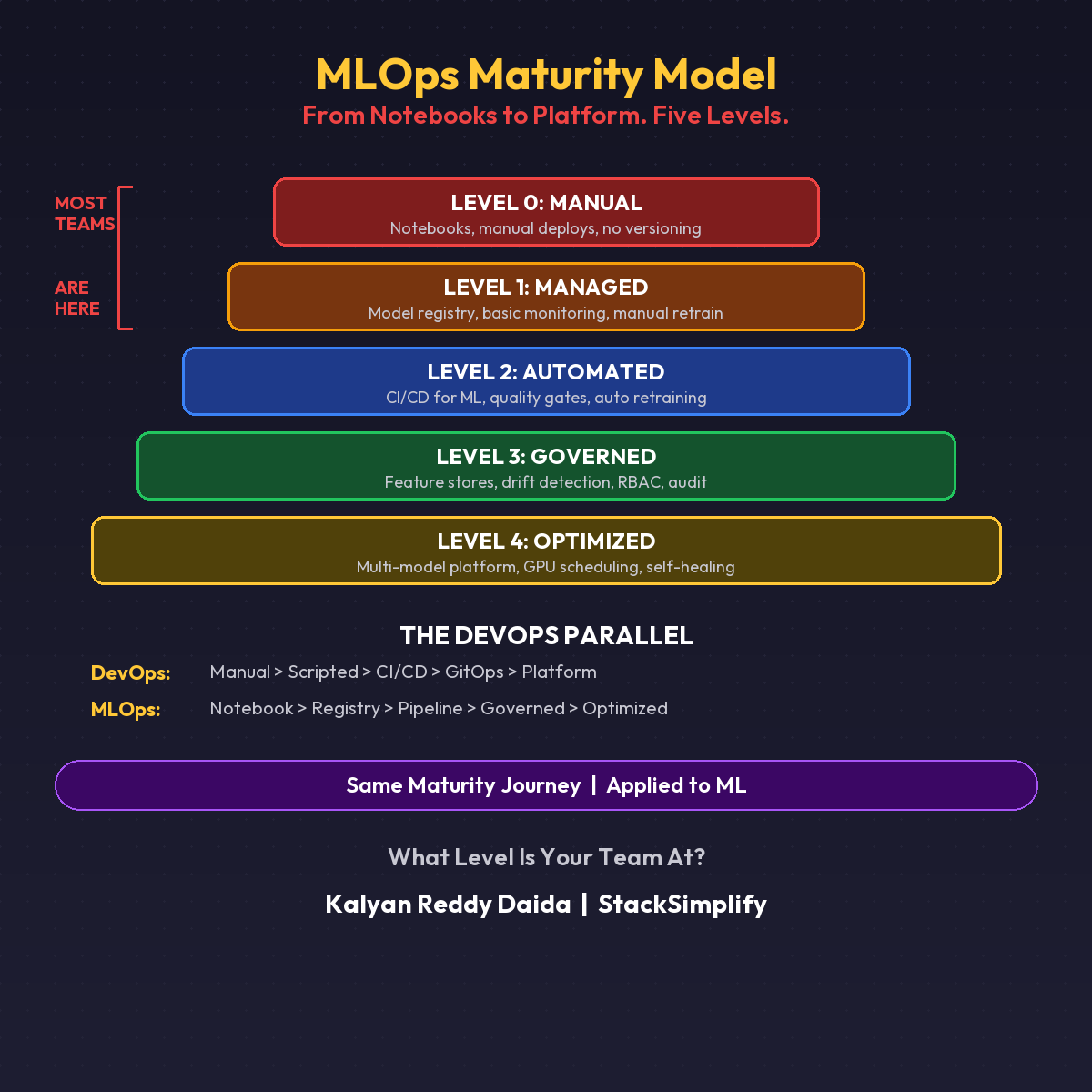
The Five Levels
| Level | Name | What It Looks Like |
|---|---|---|
| 0 | Manual | Notebooks copied to prod. No versioning. Single person dependency. |
| 1 | Managed | Model registry, basic monitoring, manual retraining with a process. |
| 2 | Automated | CI/CD pipelines, automated retraining triggers, quality gates. |
| 3 | Governed | Feature stores, A/B testing, drift-triggered retraining, RBAC, audit trails. |
| 4 | Optimized | Multi-model platform, GPU scheduling, cost optimization, self-healing. |
Level 0: Manual
Notebooks copied to production servers. Models deployed by the person who trained them. No versioning. No monitoring. No rollback plan.
If that person leaves, the model becomes an artifact nobody can reproduce.
Signs you are here: Models run from Jupyter notebooks in production. Only one person can deploy. No experiment tracking. If it breaks, you retrain from scratch manually.
Level 1: Managed
Model registry tracks versions. Basic monitoring catches crashes (not drift). Retraining happens when someone remembers to do it.
There is a process, but it is manual and person-dependent.
Signs you are here: Model registry stores trained models with versions. Basic health monitoring (uptime, latency, errors). Retraining follows a documented process. Someone has to remember to retrain.
Level 2: Automated
This is where most teams get stuck. Manual processes become pipelines. Human triggers become automated triggers. Ad-hoc comparisons become quality gates.
Three things you need:
- CI/CD pipeline for ML: train, evaluate, compare, deploy. The pipeline decides, humans approve.
- Automated retraining triggers: schedule-based, drift-based, or performance-based.
- Quality gates: candidate must strictly beat champion on a fixed test set. No exceptions.
Level 0 to 1 is tooling. Level 1 to 2 is process. You are changing how the team works. That is harder than installing software.
Level 3: Governed
Where ML becomes enterprise-ready. The governance layer.
| Capability | What It Adds |
|---|---|
| Feature stores | Training and serving use the same feature definitions. No training-serving skew. |
| A/B testing | Real traffic measures real business outcomes, not just test-set metrics. |
| Automated drift response | Drift detection triggers retraining pipelines without humans in the loop. |
| RBAC + audit trails | Who promoted what, when, with what data, with what comparison result. Every action logged. |
Who needs Level 3? Regulated industries (finance, healthcare). Teams serving multiple models. Organizations where model decisions affect customers directly.
Two-person team with one model? Level 2 is fine. Level 3 solves organizational scale problems.
Level 4: Optimized
Platform engineering applied to ML. Most teams will not need this. The ones that do, know it.
| Capability | Reference |
|---|---|
| Multi-model platform | Dozens of models on shared infrastructure |
| GPU scheduling | Kubernetes + Karpenter allocating across training and inference |
| Cost optimization at scale | Spot for training, reserved for inference, automated right-sizing |
| Self-healing | Failed health checks trigger rollback. No pages at 3 AM. |
The DevOps Parallel
You have seen this progression before:
| Level | DevOps | MLOps |
|---|---|---|
| 0 | Manual deploys via SSH | Notebooks copied to prod |
| 1 | Scripted deploys + basic monitoring | Model registry + uptime monitoring |
| 2 | CI/CD pipelines with automated testing | CI/CD pipelines with quality gates |
| 3 | GitOps with policy enforcement + audit | Feature stores + A/B + RBAC |
| 4 | Platform engineering + self-service | Multi-model platform + self-healing |
Same maturity curve. Different artifact. Code vs models.
Where Most Teams Actually Are
Let’s be honest. Most ML teams are at Level 0 or Level 1. Notebooks in production. Manual retraining. No quality gates. No drift detection.
That is not a criticism. That is a starting point.
You do not jump from Level 0 to Level 4. You climb one level at a time, solving the problems that hurt most first.
Self-Assessment Rule
Your level is the highest level where ALL statements about that level are true. Be honest. A team with a registry but no automation is Level 1, not Level 2.
| Level Test | Check |
|---|---|
| Level 1 | Can someone other than the original author retrain and deploy this model? |
| Level 2 | Does a pipeline decide deployment, or a human? |
| Level 3 | Are features identical between training and serving? Is there an audit trail? |
| Level 4 | Does GPU utilization average above 60% across the platform? |
How to Climb
| From | To | Effort | Time |
|---|---|---|---|
| 0 → 1 | Install MLflow. Register one model. Add 3 monitoring metrics. | 1 week | |
| 1 → 2 | Build one CI/CD pipeline. Add quality gate. Schedule retraining. | 1 month | |
| 2 → 3 | Adopt a feature store. Wire A/B testing. Add RBAC + audit. | 3-6 months | |
| 3 → 4 | Multi-tenancy. GPU pool. Cost dashboards. Self-healing automation. | 6-12 months |
Maturity is not about reaching the top. It is about being at the right level for your needs.
Quick Reference
- Foundation tools (Level 0 → 1): MLflow, DVC, Prometheus
- Automation tools (Level 1 → 2): GitHub Actions, KServe, Kubeflow Pipelines
- Governance tools (Level 2 → 3): Feast, Evidently, Istio
- Platform tools (Level 3 → 4): Karpenter, Knative, OpenTelemetry
This is Part 24 of the MLOps for DevOps Engineers series. Hands-on MLOps and DevOps courses are available at stacksimplify.com/courses. For weekly updates, join the newsletter. (Final post: Part 25: The Complete MLOps Platform ties all 25 posts into one architecture.)