MLOps
KServe
Cost Optimization
Kubernetes
2 min read
216 words
Scale-to-Zero for ML Models: Stop Paying for Idle Compute
Your ML model runs 24/7. Inference requests come 2% of the time. KServe plus Knative scales to zero when idle. Here is how.
Your ML model runs 24/7. Inference requests come 2% of the time. You’re paying for 98% idle compute.
This is the most expensive mistake in ML deployment. And the fix takes one YAML field.
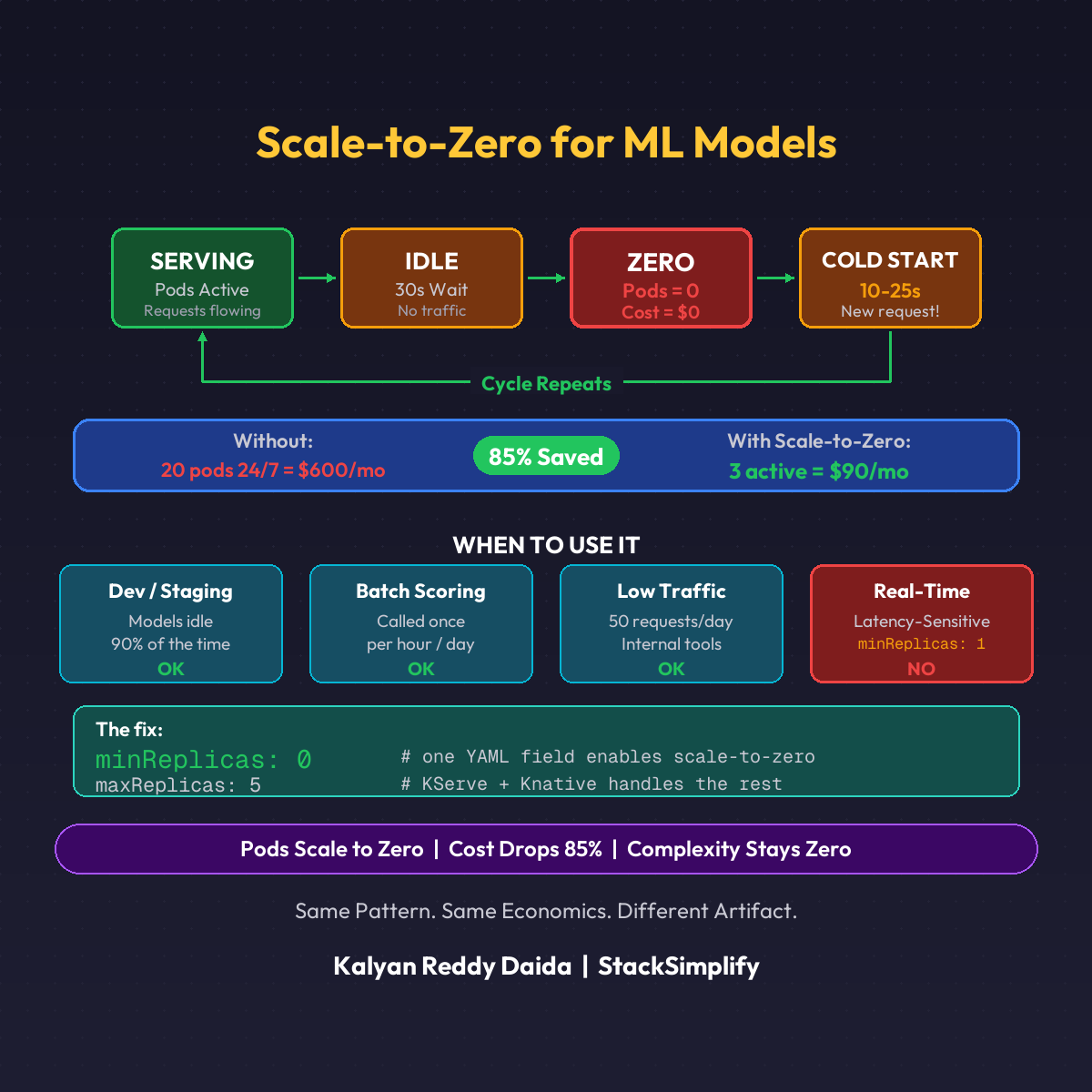
How It Works
KServe + Knative handles this natively.
- Your model is serving requests
- Traffic drops. 30 seconds of silence
- Knative scales pods to ZERO
- New request arrives
- Pod spins up in seconds. Request served.
Zero requests = zero pods = zero cost.
The Cold Start Trade-off
| Metric | Time |
|---|---|
| Pod startup | 5-15 seconds |
| Model loading | 2-10 seconds |
| First prediction total | 10-25 seconds |
For real-time APIs? Too slow. For batch scoring? Perfect. For dev/staging? No-brainer.
When to Use Scale-to-Zero
| Use Case | Scale-to-Zero? |
|---|---|
| Dev and staging environments | Yes. Idle 90% of the time |
| Batch scoring endpoints | Yes. Called once per hour/day |
| Low-traffic models (50 req/day) | Yes. Best cost-performance ratio |
| 20 models deployed, 3 active | Yes. Scale-to-zero the other 17 |
| Real-time, latency-sensitive | No. Keep minReplicas: 1 |
The DevOps Parallel
You already know this pattern.
- Lambda scales to zero when idle
- Knative does the same for containers
- KServe does the same for ML models
Same pattern. Same economics. Different artifact. (More cost strategies in Part 18: ML Cost Optimization.)
This is Part 8 of the MLOps for DevOps Engineers series. For weekly updates, join the newsletter.